Shopify's AI setting says yes to channels that don't exist yet
Shopify now lists a store's products in AI shopping channels: ChatGPT, Microsoft Copilot, Google AI Mode and Gemini, Meta. The setting that controls it ships switched on. That part is ordinary. Plenty of settings ship on.
By Rish Sadh, founderUpdated
One line further down
The part worth a page is one line further down. With the default on, a store is "auto-enrolled in new agentic storefronts channels." The merchant doesn't make this decision once. Each time Shopify adds a channel, the catalogue goes to it without a new decision by the person who owns it. Meta was added on 8 September 2026, and Shopify's changelog said it plainly: "Your products are shared with Meta by default through Shopify Catalog."
I build Shopify stores and can open the admin of three. Below is what Shopify's own pages say, every line read on 6 October 2026, what Shopify said earlier, and what the settings page shows on the two stores where my account is allowed to see it.
In short
- On by default: "Allow Shopify to manage for me is the default behavior for Shopify's agentic storefronts."
- Future channels included: "You're auto-enrolled in new agentic storefronts channels."
- Agreement happens by selling. The admin page says: "By selling on these sales channels, you agree to Agentic Storefronts Supplemental Terms."
- No is slow: switching off catalogue access "can take up to 7 days".
- Some of it can't be switched off: "You can't opt out of Shopify Catalog itself."
What the default does
The setting is called Allow Shopify to manage for me. What it does when it's on, from Shopify's help page:
When this setting is turned on: Agentic storefronts channels have access to your products through Shopify Catalog. Direct checkout is activated for the relevant channels. You're auto-enrolled in new agentic storefronts channels.
One switch covers three decisions: access to the products, checkout inside the AI channel where the channel offers it, and enrolment in channels that haven't launched yet.
What the channels receive, in Shopify's words: "Product data such as titles, descriptions, images, pricing, and availability information." When a customer buys inside a channel with direct checkout, that channel also gets "the customer's name, email address, phone number, and physical address", the details it needs to complete the order.
The list isn't only the big names. Switch the default off and a group called Other channels appears, which covers "Independent developers and startups that are building niche or experimental shopping agents" and "New third-party partners that have recently gained access to Shopify Catalog for testing." In the admin, its tooltip reads: "Other AI-powered platforms like Perplexity that can surface your products to shoppers".
How the wording changed
Shopify didn't start here. At launch, in December 2025, the pitch was choice: "Just toggle AI platforms on or off individually to choose which channels you sell in."
| Date | What Shopify said | Where |
|---|---|---|
| 10 Dec 2025 | "Just toggle AI platforms on or off individually to choose which channels you sell in." | Shopify News, launch |
| 11 Mar 2026 | "This agentic storefront channel will launch by default for your store, and you will be able to modify settings in your Admin." | Email to merchants, reported by Modern Retail and confirmed by Shopify |
| 24 Mar 2026 | "Products become discoverable in ChatGPT by default via Agentic Storefronts" | Shopify News |
| 6 Apr 2026 | "You can't explicitly opt out of selling with Shopify's agentic storefront for ChatGPT." | ChatGPT help page, archived copy |
| May to June 2026 | Allow Shopify to manage for me and auto-enrolment appear in the help pages | Absent from an archived copy of 9 May, present on 17 June |
| 18 Jun 2026 | "For merchants, there's nothing to configure." | Shopify's blog |
| 8 Sep 2026 | Meta added. "Your products are shared with Meta by default through Shopify Catalog." | Shopify Changelog |
Where it stands now
The ChatGPT page today explains how to remove ChatGPT's access, which it didn't in April. The controls exist now. A store that never opens the Agentic page keeps the default.
What two real stores show
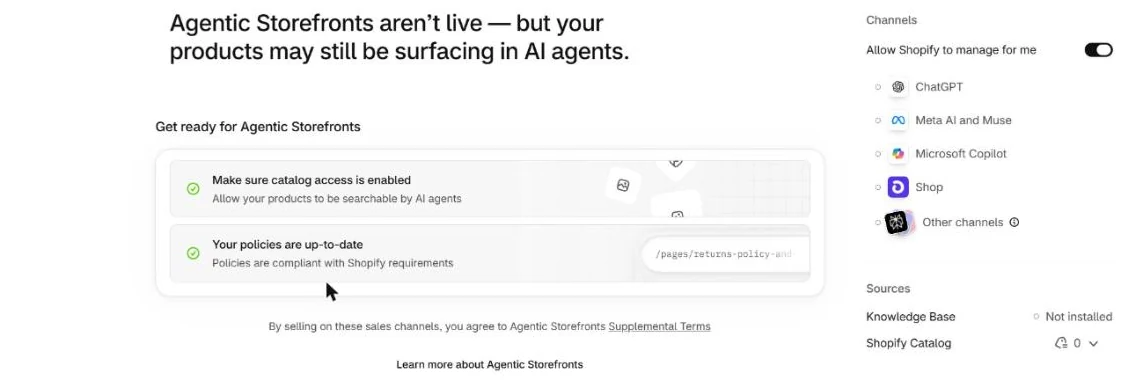
The first store's page opens with "Agentic Storefronts aren't live", then "but your products may still be surfacing in AI agents." Allow Shopify to manage for me is on.
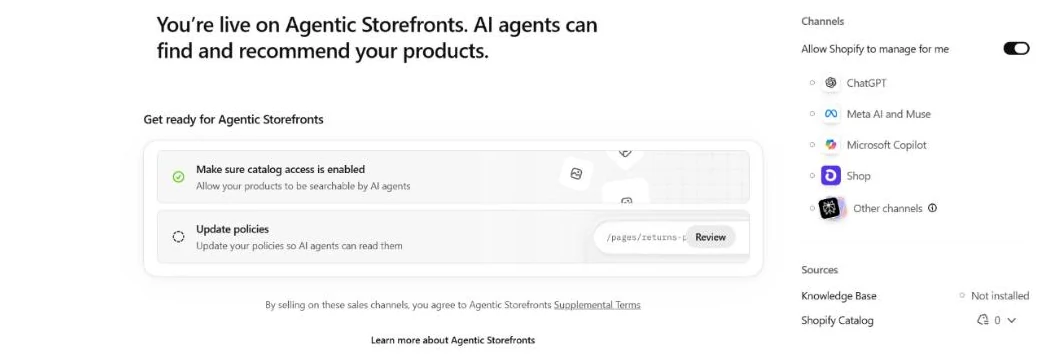
The second store's page said "You're live on Agentic Storefronts. AI agents can find and recommend your products." The switch was on there too.
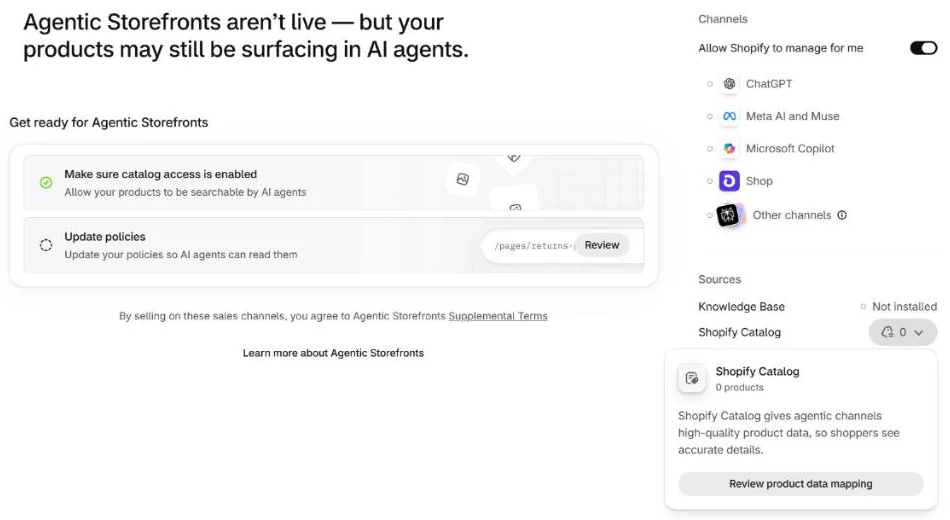
I opened the second store again at 09:42. I had changed nothing. The headline now said "Agentic Storefronts aren't live", then "but your products may still be surfacing in AI agents", and it said the same after a reload. The switch still read on. The Shopify Catalog count under Sources read "0 products".
I can't tell you why the headline changed. On one store, in 39 minutes, the line that tells an owner whether they are live said two different things, while the switch underneath read on both times. The switch is the setting. The headline is a summary of it.
Both pages carry the same line under the checklist: "By selling on these sales channels, you agree to Agentic Storefronts Supplemental Terms." On this page, selling is the agreement.
The third store doesn't show me this page at all. Shopify's help says you need to be the store owner or hold the "Products > View and App and sales channel > Agentic staff permissions", and my account there doesn't. The person who built a store may never see this setting.
What saying no does, and doesn't
Turning off catalogue access is slow: "If you turn off Shopify Catalog access, then it can take up to 7 days before your product data is no longer being shared through Shopify Catalog."
It is also partial. Three lines from Shopify's help pages:
- "When access is deactivated, your products can still be discovered through web crawling and indexing."
- "Shop doesn't have the option for you to deactivate Shopify Catalog access in Sales channels > Agentic in your Shopify admin." Shop is Shopify's own shopping app.
- "You can't opt out of Shopify Catalog itself."
Blocking AI crawlers in robots.txt doesn't stop it either. From Shopify's products page: "Blocking AI crawlers at the /robots.txt or network layer affects only open-web discoverability. It doesn't stop your product data from being sent by Shopify Catalog to the agentic storefronts that you've activated."
The one full exit Shopify documents is to mark products Unlisted, which also hides them "from sitemaps, search engines such as Google, and your online store search."
Turning the default back on switches everything back on: "If Allow Shopify to manage for me is off, then turning it back on automatically activates all agentic storefronts settings, including direct checkout."
Merchants noticed before the current controls existed. On Shopify's Community forum on 4 April 2026, one wrote: "For the new "Agentic Storefronts", not only does it not wait for sellers to Opt In, it doesn't allow us to Opt Out."
What the terms say
Not a legal reading. These are the lines as written in the Agentic Storefronts Supplemental Terms of Service, last updated 7 July 2026.
On new channels, section 3: "Your continued participation in Agentic Storefronts after additional Participating Channels are added constitutes your acceptance and agreement to the respective Participating Channel Terms."
On saying no, section 8: "If you do not wish to participate in using the features of Agentic Storefronts with a particular Participating Channel, it is your responsibility to disable the features for that Participating Channel for your Shopify Store in your Shopify Admin."
On your product content, section 5: the licence Shopify already holds "is sublicensable to Shopify partners and their affiliates operating Participating Channels for their use of your Materials in connection with their platforms, systems, and services."
On fees, the help pages and the terms read differently. The help page for each checkout channel says, for Meta for example: "There are no fees associated with selling in Meta's direct checkout. You pay only your standard payment processing fees." Section 6.1 of the terms: "For certain Participating Channels, Shopify may, in its discretion, assess a fee on transactions that occur as a result of your participation in Agentic Storefronts."
Where Shopify's own pages disagree
The top-level help page says agentic storefronts "is active by default for eligible stores." The same page says "you must read and agree to the Shopify Agentic Storefronts Supplemental Terms of Service." The admin line in section 03 is the only place I found that joins the two: you agree by selling.
"Eligible stores" has no single definition. The terms say "Shopify may determine, in its sole discretion, whether you or your Store are eligible" and send you to the help documentation. The help documentation spreads it across pages: ChatGPT needs a store that sells to customers in the United States, Meta needs one that sells in the United States, Canada or Mexico, and so on.
On Meta, the pages contradict each other. The Meta page: "Products are made available on Meta through Shopify Catalog." The data and privacy page: "For Google AI Mode and Gemini and Meta, product discovery is powered by individual sales channels rather than a Shopify Catalog access setting."
So don't settle this from the documentation. Open your own Agentic page, and look at it twice.
What this page doesn't say
- That Shopify is hiding anything or acting improperly. Every line here is in Shopify's public documentation, news or terms.
- How many stores have the default on. Shopify hasn't published a number, and I don't have one.
- What any AI channel does with product data beyond what the terms say.
- What the setting is on any store but the two shown, or why the second store's headline changed.
- Whether a store's opt-outs also reach Shopify's developer catalogue for third-party agents. The help pages don't say.
Check yours
In Shopify admin: Sales channels, then Agentic. Allow Shopify to manage for me is at the top right. Turn it off and three controls appear: Shopify Catalog access, Auto enroll new storefronts, and one row per channel. The Shopify Catalog count under Sources tells you how many of your products are in the catalogue today.
Sources
Read 6 October 2026 unless marked.
- Shopify Help Center: Shopify agentic storefronts
- Shopify Help Center: Managing agentic storefronts
- Shopify Help Center: Data sharing and privacy for selling with agentic storefronts
- Shopify Help Center: Shopify Catalog and product discovery for agentic storefronts
- Shopify Help Center: Selling on ChatGPT
- Shopify Help Center: Selling on Meta
- Shopify Help Center: Shopify Catalog
- Shopify Agentic Storefronts Supplemental Terms of Service, last updated 7 July 2026
- Shopify Changelog: Meta is now an AI channel in your admin, 8 September 2026
- Shopify News: Introducing Shopify Agentic Storefronts, 10 December 2025
- Shopify News: Millions of merchants can sell in AI chats, 24 March 2026
- Shopify blog: Agentic Commerce on Shopify: How It Works, 18 June 2026
- Modern Retail: Shopify says purchases are coming inside ChatGPT, 12 March 2026
- Archived copy: Selling on ChatGPT, captured 6 April 2026
- Archived copy: Shopify agentic storefronts, captured 9 May 2026
- Archived copy: Managing agentic storefronts, captured 17 June 2026
- Shopify Community: Not allowed to opt out of generative AI agentic storefronts, 4 April 2026
The screenshots were captured by an AI agent driving my signed-in Chrome. It changed no setting.
The same method on four identity checks: Four front doors to "prove you're human".
Rish Sadh, founder of Reidify, an AI-first design studio in Mumbai.